Vessels are intricate machines with numerous components working in tandem to navigate the vast oceans. Among these crucial components is the stern tube air seal system, a vital mechanism that plays a pivotal role in ensuring the smooth operation and longevity of a ship’s propulsion system. In this article, we’ll explore the operation of the stern tube air seal system, its maintenance requirements, troubleshooting techniques, and the indispensable role of onboard marine engineers in keeping this system running seamlessly.
Operation of Stern Tube Air Seal System
The stern tube air seal system is designed to prevent seawater from entering the ship’s stern tube, which houses the propulsion shaft. This shaft connects the ship’s engine to the propeller, allowing the vessel to move forward.

With growing environmental awareness, the maritime industry is under pressure to reduce its ecological footprint. Stern tube lubricating oil systems can potentially lead to oil leaks and spills if not properly maintained. As a result, ship designers and operators are exploring environmentally friendly lubricants and innovative seal technologies to mitigate these risks.
Nowadays, on the new modern vessels, the aft main seal is an air type seal operation, clean filtered compressed air is used as the means of controlling and maintaining the seal differential pressure.
Simplex airspace sterntube seal. Source and credit: BAHR visuelle Kommunikation
The air seal system operates by maintaining a positive pressure of air within the stern tube. This pressure prevents seawater from entering the system, creating a barrier that safeguards the propulsion shaft and its associated bearings and seals. The system typically consists of air supply units, pressure sensors, control valves, and monitoring devices, all working together to maintain optimal conditions.
Air guard seal. Source and credit: Wartsilacorp
As can be seen air is supplied to the space formed by no.2 and no.3 sealing rings which then flows into the space formed by no.1 and no.2 sealing rings before flowing out to the sea. The air is supplied from a control unit and the flowrate is adjusted so that there is always the same differential pressure no matter what the draught of the vessel. The space formed by no.2 and no.3 sealing rings is open to the stern tube sump tank, so if the oil sealing rings no.3 and no.3S are damaged, any oil entering the space formed by no.2 and no.3 sealing rings is drained to the stern tube sump tank.
Stern tube bearing lubricating oil is supplied by one of the stern tube LO circulating pumps which take suction from the stern tube sump tank, which on modern vessel is maintained under pressure by air from the air control unit. The pressure in the stern tube LO tank provides the same effect as gravity tank fitted in the LO system, which is for emergency use if the air supply to the stern tube tank will fail.
The air control unit is equipped with flow regulators which are adjusted to provide constant air flow rate to the stern tube seal. Any alteration in the vessel draught is automatically compensated for by the changes in pressure of the air supplied.
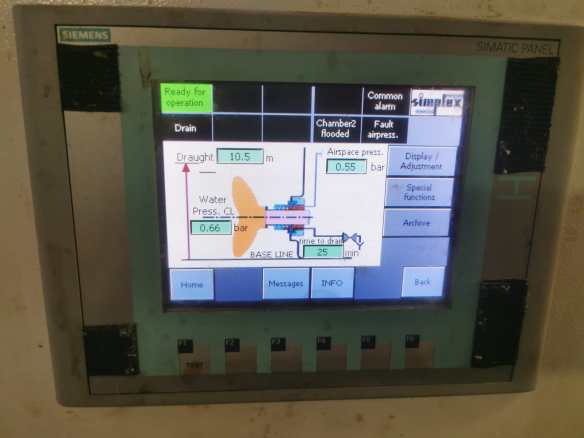
The leakage past no.1 and no.2 sealing rings will be dependent on the general condition of the seals and the condition of the shaft liner. Any oil and sea water that may be present in this space is drained into the drain tank which should be checked regularly as it warns the duty engineer of any seal leakage problems. If the tank contains sea water, no.1 and no.2 seals are leaking, but if contains oil, then it is the seal no.3 that is leaking.
If the air supply fail or there is a disruption in the air supply from the air control unit to the stern lubricating oil tank the aft seal can be converted to the emergency seal condition. This is done by bypassing the lubricating oil tank and using the return pipe system to maintain a positive head on the oil in the stern tube. In the event of this kind of failure the system will trigger an alarm and system valves should be changed in order to ensure that an oil supply is maintained at the aft seal. In this case the stern tube bearing system must be converted to the gravity tank system in order to maintain the desired lube oil pressure, as this is necessary because there will no air pressure acting on the system.
The aft seal space between rings no.1 and no.2 may be flushed through with fresh water when necessary as the water is supplied at the connection to the air control unit.
Maintenance of Stern Tube Air Seal System
Proper maintenance is crucial for the reliable performance of the stern tube air seal system. Marine engineers play a key role in executing routine checks and tasks to ensure the system’s efficiency. Here are essential maintenance steps:
-
Regular Inspections: Conduct visual inspections of the air seal system components, checking for any signs of wear, corrosion, or damage. Inspect air supply units, pressure sensors, and control valves for proper functioning.
-
Air Pressure Monitoring: Regularly monitor and adjust the air pressure within the stern tube. Deviations from the recommended pressure levels can indicate potential issues that require attention.
-
Lubrication Checks: Verify the lubrication systems associated with the stern tube bearings and seals. Inadequate lubrication can lead to increased friction and premature wear.
-
Seal Integrity Testing: Perform seal integrity tests to ensure that the air seals effectively prevent water ingress. This may involve shutting down the system and conducting a thorough examination.
Troubleshooting Stern Tube Air Seal System Issues
Despite regular maintenance, issues may arise with the stern tube air seal system. Marine engineers must be adept at troubleshooting to address problems promptly and prevent extensive damage. Common issues include:
-
Air Leakage: If there is a drop in air pressure within the stern tube, it may indicate air leakage. Engineers should inspect seals, valves, and connections for leaks and rectify them promptly.
-
Excessive Wear: Wear and tear on bearings and seals can lead to increased friction. Regular inspections and monitoring can help identify worn components before they compromise the system’s performance.
-
Inadequate Lubrication: Insufficient lubrication can result in increased heat and friction. Engineers should check lubrication systems, ensuring they are delivering the required amount of oil to bearings and seals.
In conclusion, the stern tube air seal system is an indispensable component in the smooth operation of a vessel’s propulsion system. By understanding its operation, conducting regular maintenance, and promptly addressing issues, marine engineers play a crucial role in ensuring the reliability and efficiency of this system. As the guardians of a ship’s mechanical heart, onboard engineers contribute significantly to the safety and longevity of maritime journeys.
If you want to learn more about “Propulsion Systems and Load Lines“, please follow THIS LINK on Alison platform. The course is free and all you need to do is just to subscribe to their platform using the link above. This will be of a great help to me as well, as I will earn small commission. You can consider this as a reward for my effort to provide guidance and advices with regard to complex, challenging and rewarding marine engineering.
If you have any questions regarding above, please feel free to use our existing forum Seafarer’s World, Telegram Chief Engineer’s Log Chat or Instagram and will try to answer to all your queries. You can use the feedback button as well!
If you like my posts, please don’t forget to press Like and Share. You can also Subscribe to this blog and you will be informed every time when a new article is published.
Also you can buy me a coffee by donating to this website, so I will have the fuel I need to keep producing great content! Thank you!


Pretty! This has been a really wonderful post. Many thanks for providing these details.
I do not even know how I ended up here but I thought this post was great I do not know who you are but certainly youre going to a famous blogger if you are not already Cheers
It was great seeing how much work you put into it. The picture is nice, and your writing style is stylish, but you seem to be worrying that you should be presenting the next article. I’ll almost certainly be back to read more of your work if you take care of this hike.
I loved as much as you’ll receive carried out right here. The sketch is tasteful, your authored material stylish. nonetheless, you command get bought an nervousness over that you wish be delivering the following. unwell unquestionably come more formerly again since exactly the same nearly a lot often inside case you shield this hike.